
Technology
Massive heat pump and underground loop planned for Seattle University energy pilot
By Marcus Chen
Capitol Hill Seattle Blog
Advertisement
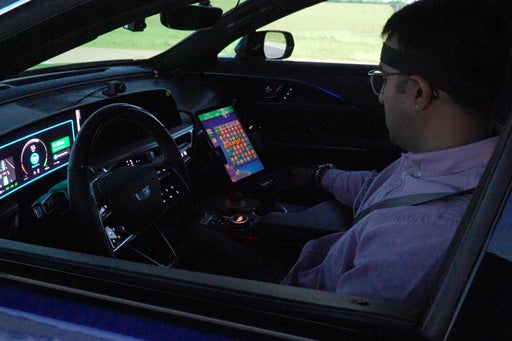
From ‘hands-free’ to ‘eyes-off’: how General Motors is simulating its way to autonomous driving By ALEXA ST. JOHN and MIKE HOUSEHOLDER The Associated Press In this image from video, General Motors senior researcher Akilesh Rajavenkatanarayanan plays Candy Crush on a tablet mounted in a Cadillac Lyriq while it is in "eyes off" mode during a simulated drive at the automaker's Global Technical Center Friday, Sept. 18, 2026, in Warren, Mich. (AP Photo/Mike Householder) WARREN, Mich. (AP) — At the General Motors Global Technical Center in Warren, Michigan, in suburban Detroit, hundreds of volunteer, real-world drivers have hopped inside a Cadillac Lyriq electric vehicle or other popular GM models and experienced all sorts of things while in the car: regular roadway driving, driving up and down hills, construction, rain, nearby traffic and other scenarios. But while the vehicle is real, the world that the drivers are experiencing is not. Instead, they’re inside a simulator; a 360-degree, immersive environment where their every eye movement, heart stress, sweating and other reactions are measured against countless driving tests. Here, GM is testing a human driver’s response in vehicles just as much as it’s testing the vehicle tech itself. That simulation is how GM — and other automakers — are testing future iterations of their advanced driver assistance systems. Also called ADAS, this technology so far allows for well-known vehicle features such as automatic emergency braking, blind spot warnings, lane departure warnings, lane-centering assist, surround-view cameras, driver attention monitors and many more. These features let drivers go “hands-free” at certain times, particularly while on the highway.Automakers anticipate that these systems will eventually grow so advanced that drivers will be allowed to safely take their hands off the wheel, and their eyes off the road. But the race is not only about the technology itself, but the payoff, which is a big one. Automakers with the best tech will get more consumers to subscribe to those capabilities, making automated driving a lucrative play for the industry.“Going eyes off is really the turning point where consumers will be more willing to pay for this feature, because when you go eyes off, now you’re really potentially giving the driver back some time, because they don’t have to be paying attention to the road,” said Sam Abuelsamid, vice president of market research at firm Telemetry. “That’s where they see the real value proposition.”GM says its version will be possible by 2028, when it’s launching the next Super Cruise on the Cadillac Escalade IQ luxury electric sport utility vehicle. Others are on their heels.“2028 is the broad timeline when there’s a whole group of companies that are all targeting launching systems like this that can operate at highway speeds,” Abuelsamid added, “on a wider variety of roads than what we see with a lot of the systems today.” GM’s tech evolving from ‘hands-free’ to ‘eyes-off’Since 2017, GM has sold vehicles with Super Cruise, a hands-free, assisted driving system — notably not self-driving — that’s available to use on over 630,000 roads in the U.S. and Canada, and more around the world. “You can take your hands off the wheel and keep your eyes on the roads, but safely enjoy a de-stressed drive on those roads in your normal, everyday commutes,” said Tyson Becker, GM executive director for autonomous vehicle strategy and product.There are now more than 20 different GM models across its four brands — Cadillac, GMC, Buick and Chevrolet — equipped with the technology. The automaker plans to expand the number of models available with Super Cruise in the coming years with the ultimate goal of launching the next generation of Super Cruise, technology that allows for safe, “eyes-off” driving. “What we’re talking about is truly a technology that is so safe that it allows you to take your eyes off the road while it’s active, and do other things in the cabin, whether that is looking at your phone, looking at your laptop, taking a meeting, watching a movie,” Becker added. Simulation is part of what makes that future possible One of the most challenging aspects of developing autonomous technology is predicting, and getting a vehicle to respond to countless, unexpected scenarios while on the road. That could mean a dog, deer, or even a child, sprinting onto a road; a detour unforeseen on a navigation app or a suddenly active construction zone. A driver — or in this case, the technology — needs to be able to recognize that the immediate environment has changed, and to respond in a safe way.That’s largely where simulation, combined with data collection and artificial intelligence, comes in.In GM simulations, drivers of all experience levels take the wheel and face a multitude of computer-generated scenarios on highways or urban landscapes replete with other “humans” and roadway signage. “We want to really be able to take anything that our customers could experience out on the road,” said Maureen August, senior manager at GM Research & Development. The ultimate GM challenge for drivers … Candy CrushAs participants drive in the simulator, GM looks at key data points, like heart rate, stress, where the driver’s eyes are going, how long they are looking at one part of the road or another and how they are attending to the road, all from a nearby control room.One of the best ways to test driver attention these days: inviting drivers to play Candy Crush.“We found it’s very effective for getting people involved and wanting to get the highest score,” August said. “It’s a great way for us to get you engaged and then have to pull you away from a task.”After participants drive, they’re asked how they felt, how they understood the system, and whet
By Marcus Chen
Capitol Hill Seattle Blog

By Marcus Chen
City AM

By Katherine Langford
WCCO / CBS Minnesota

By Marcus Chen
Minnesota Reformer